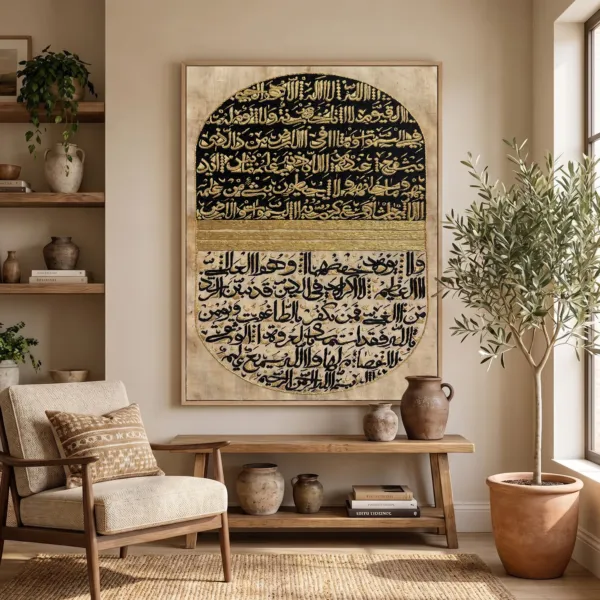
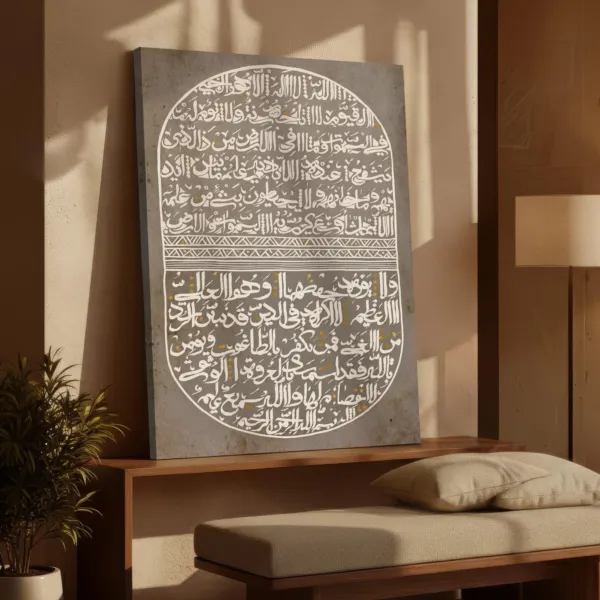
Quick answer: Ayatul Kursi is verse 255 of Surah Al-Baqarah, known as the Verse of the Throne. It describes Allah’s life, knowledge and authority over everything. The Prophet (peace be upon him) called it the greatest verse in the Quran and taught Muslims to recite it after every obligatory prayer and before sleeping. Many families hang it in the living room or entryway as a daily reminder, treating it with the same respect as the Quran itself.
Ayatul Kursi is the verse most Muslims learn first after Surah Al Fatiha. It is recited after prayers, before sleep and when someone feels afraid, and it is the most popular verse for Islamic wall art. This guide explains what it means line by line, what the authentic hadith say about its benefits, and how to choose and hang Ayatul Kursi wall art at home.
What is Ayatul Kursi?
Ayatul Kursi (also written Ayat al-Kursi or Ayat ul Kursi) is the 255th verse of Surah Al-Baqarah, the second chapter of the Quran. Its name comes from the word kursi, usually translated as throne or footstool, which appears in the middle of the verse. It is a single verse, but it is one of the longest and most complete descriptions of Allah in the Quran.
Ayatul Kursi transliteration
Allahu la ilaha illa huwal hayyul qayyum. La ta’khudhuhu sinatun wa la nawm. Lahu ma fis samawati wa ma fil ard. Man dhal ladhi yashfa’u ‘indahu illa bi idhnih. Ya’lamu ma bayna aydihim wa ma khalfahum. Wa la yuhituna bi shay’im min ‘ilmihi illa bima sha’. Wasi’a kursiyyuhus samawati wal ard. Wa la ya’uduhu hifdhuhuma. Wa huwal ‘aliyyul ‘adheem.
Transliteration only approximates the Arabic sounds. To recite it correctly, learn it from a teacher or follow a recording by a qualified reciter.
Ayatul Kursi meaning, line by line
Below is a plain English explanation of each phrase. It is a summary of the meaning, not a replacement for a full translation and tafsir.
| Phrase | Meaning |
|---|---|
| Allahu la ilaha illa huwa | Allah: there is no god except Him. |
| al-hayyul qayyum | The Ever-Living, the one who sustains and maintains everything that exists. |
| la ta’khudhuhu sinatun wa la nawm | Neither drowsiness nor sleep overtakes Him. |
| lahu ma fis samawati wa ma fil ard | Everything in the heavens and on the earth belongs to Him. |
| man dhal ladhi yashfa’u ‘indahu illa bi idhnih | No one can intercede with Him except by His permission. |
| ya’lamu ma bayna aydihim wa ma khalfahum | He knows what is in front of people and what is behind them, their present and their past. |
| wa la yuhituna bi shay’im min ‘ilmihi illa bima sha’ | They grasp nothing of His knowledge except what He wills. |
| wasi’a kursiyyuhus samawati wal ard | His Kursi extends over the heavens and the earth. |
| wa la ya’uduhu hifdhuhuma | Guarding and preserving them does not tire Him. |
| wa huwal ‘aliyyul ‘adheem | He is the Most High, the Most Great. |
Taken together, the verse moves from who Allah is (living, sustaining, never tiring), to what He owns (everything), to what He knows (everything), and ends with His greatness. That is why scholars describe it as a summary of belief in Allah.
Benefits of Ayatul Kursi from authentic hadith
1. It is the greatest verse in the Quran
The Prophet (peace be upon him) asked his companion Ubayy ibn Ka’b which verse of the Book of Allah was the greatest. Ubayy answered that it was Ayatul Kursi, and the Prophet praised his knowledge. This is narrated in Sahih Muslim (810).
2. Protection through the night when recited before sleep
In a well-known narration in Sahih al-Bukhari (2311), Abu Hurayrah was told that whoever recites Ayatul Kursi when going to bed will have a guardian from Allah with them, and Shaytan will not come near them until morning. The Prophet confirmed that this was true.
3. A means of entering Paradise when recited after each prayer
Abu Umamah reported that the Prophet said whoever recites Ayatul Kursi after every obligatory prayer, nothing prevents them from entering Paradise except death. It is recorded by an-Nasa’i in As-Sunan al-Kubra and graded authentic by scholars of hadith.
4. Part of a household that recites Surah Al-Baqarah
Ayatul Kursi sits inside Surah Al-Baqarah, and the Prophet said Shaytan flees from a house in which Surah Al-Baqarah is recited (Sahih Muslim 780). Many families make a habit of reciting the whole surah, or at least Ayatul Kursi and the last two verses, at home.
Be careful with long lists of benefits shared online. Some quote weak or invented narrations. The ones above are from well-established collections.
Is it okay to hang Ayatul Kursi on the wall?
Hanging Quranic calligraphy at home is a long tradition across the Muslim world, from Ottoman homes to modern apartments. Most scholars allow it as a reminder, on the condition that it is respected. Some scholars discourage it, mainly when people treat a verse as a charm that protects the house by itself, or when it is used only as decoration and forgotten.
A balanced approach most families follow:
- Hang it as a reminder to recite, not as an amulet. The benefits in the hadith come from reciting the verse.
- Keep it clean and in good condition, and replace a damaged print.
- Hang it at or above eye level, never on the floor or where people sit or lean against it.
- Do not hang it in a bathroom, and keep it away from places where it could be splashed or covered by coats.
If your family follows a particular scholar, it is worth asking them, as opinions differ in the details.
Where to hang Ayatul Kursi at home
Living room
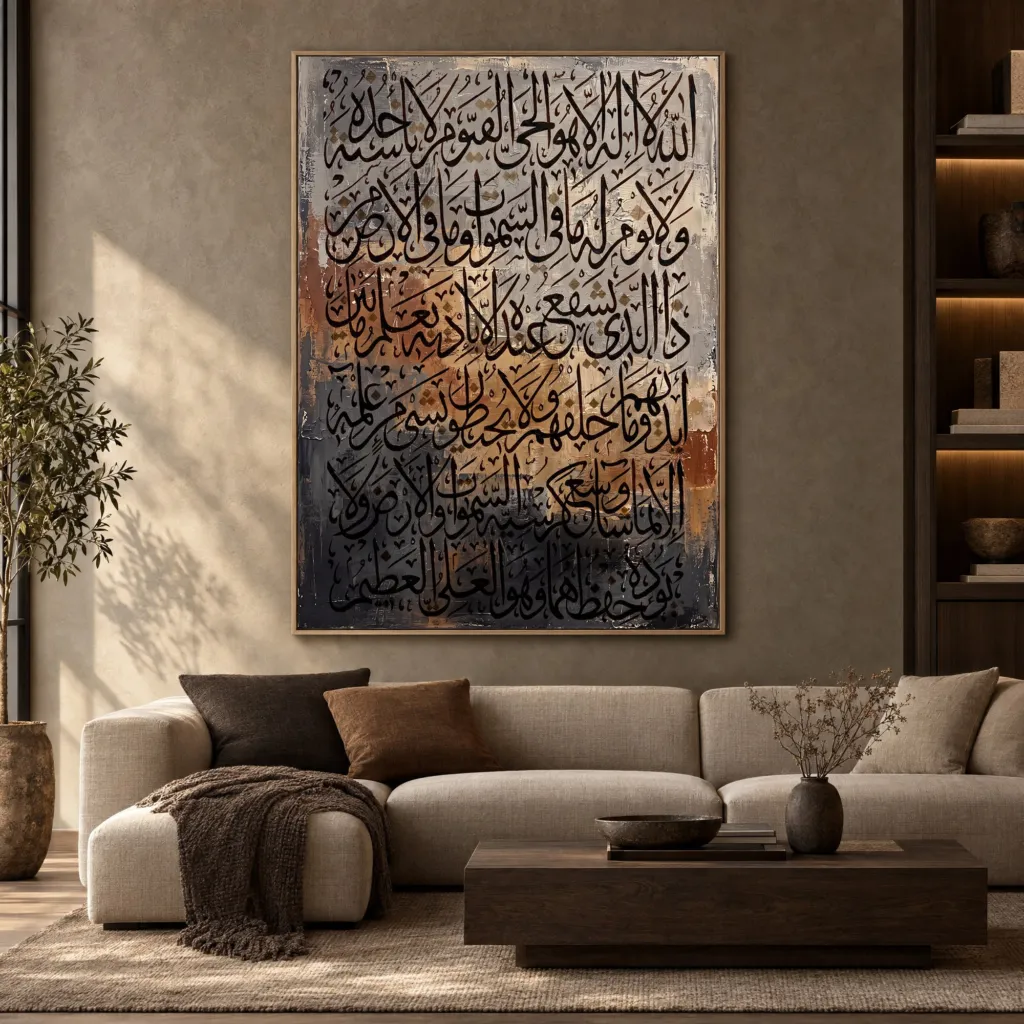
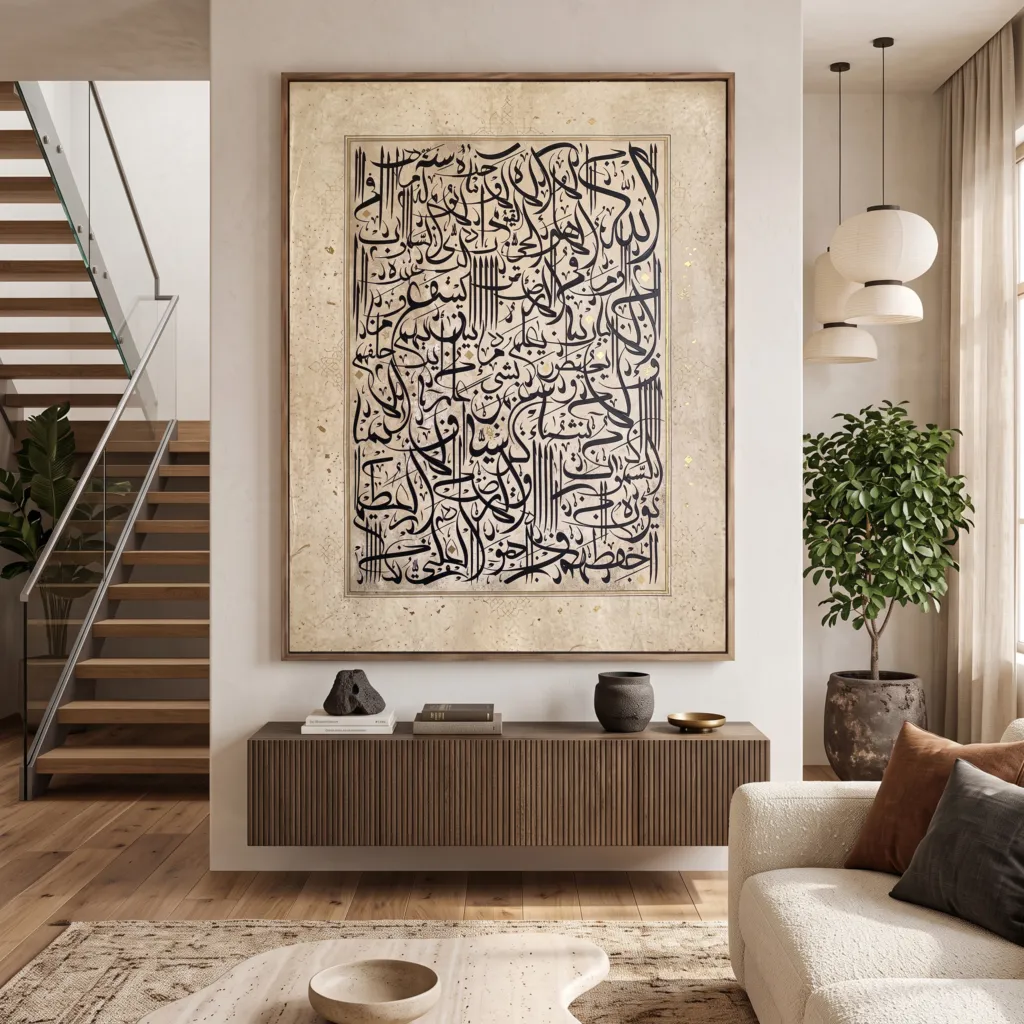
The most common place. Above the sofa or a sideboard, it becomes the first thing guests see and something the family passes many times a day. A large size such as 30 × 40 or 36 × 48 inches suits most sofas.
Entryway or above the main door
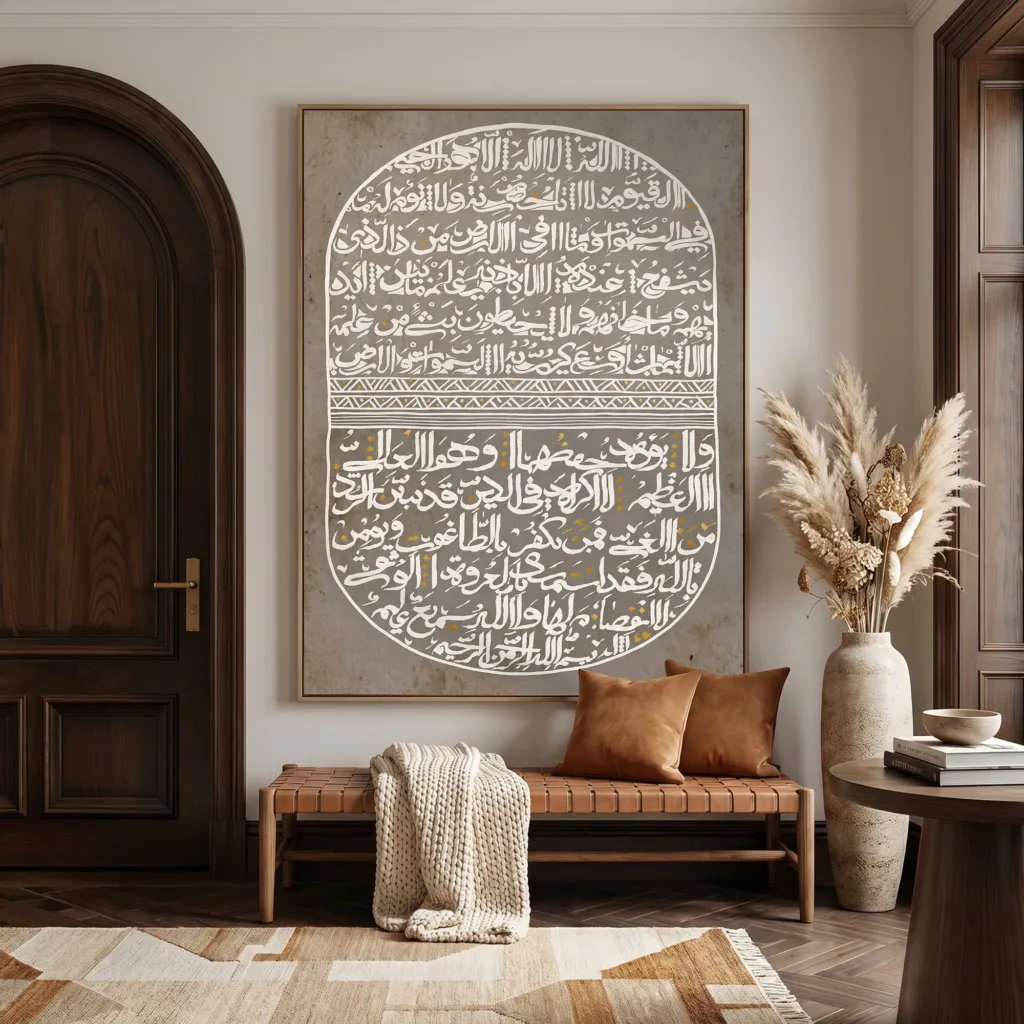
Many families hang Ayatul Kursi facing the front door or in the hallway just inside it, as a reminder to say it when leaving and arriving. A narrower wall suits 18 × 24 or 24 × 32 inches.
Hallway or staircase
A long hallway or the wall beside a staircase is a good spot for a tall piece, and it keeps the verse in a respectful, uncluttered place.
Bedroom or prayer corner
Since the Prophet taught reciting Ayatul Kursi before sleep, some families hang it in the bedroom as a nightly reminder. Others prefer the hallway outside the bedroom. Above a prayer mat or reading chair also works well.
How to choose Ayatul Kursi wall art
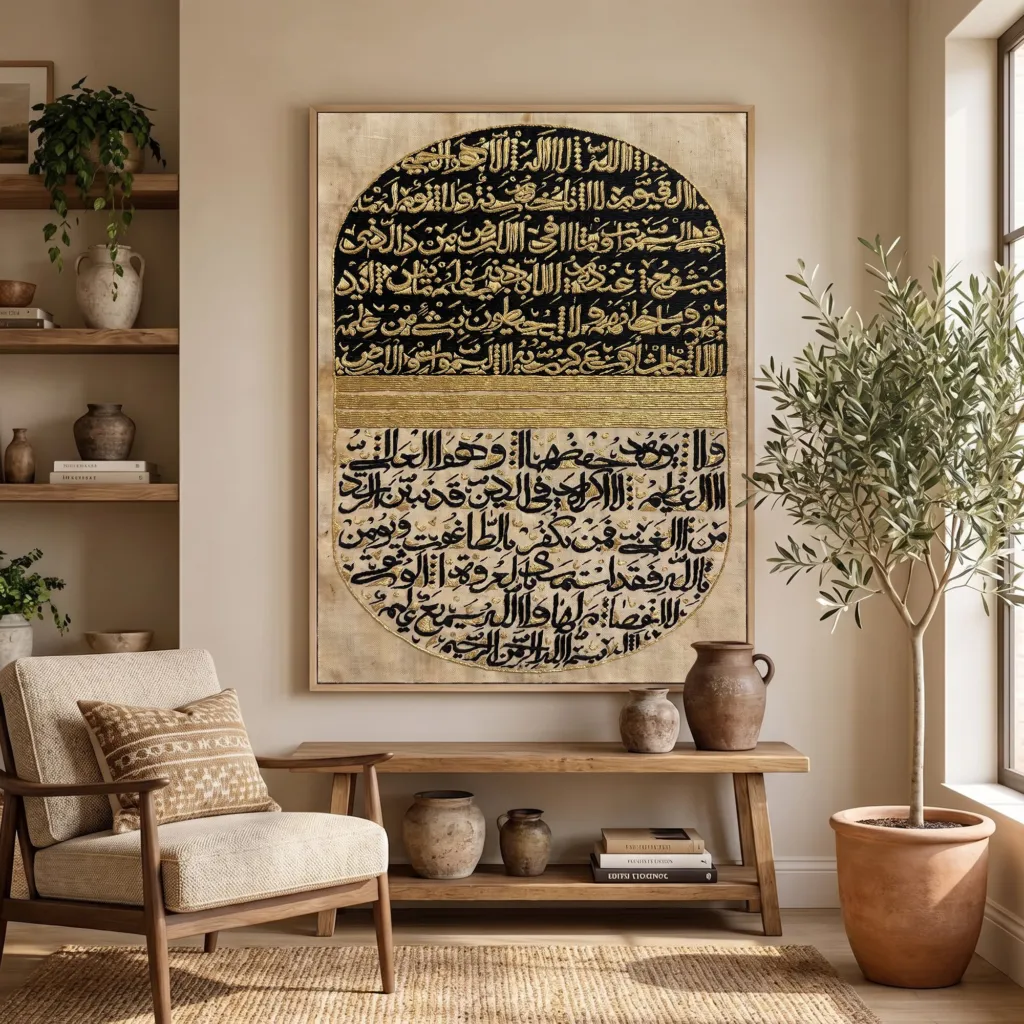
- Script style. Flowing Thuluth and Diwani scripts feel traditional and ornate. Angular Kufic and minimal modern scripts suit contemporary homes.
- Color. Black and gold reads classic and formal. Cream, taupe and light grey sit quietly in neutral rooms. Deep red, terracotta or mosaic colors make a statement.
- Shape. Arch and round designs soften a room full of straight lines. A full rectangle of script fills a large wall.
- Size. Aim for about two thirds of the width of the furniture below it. Our guide to choosing Islamic wall art has a full size chart.
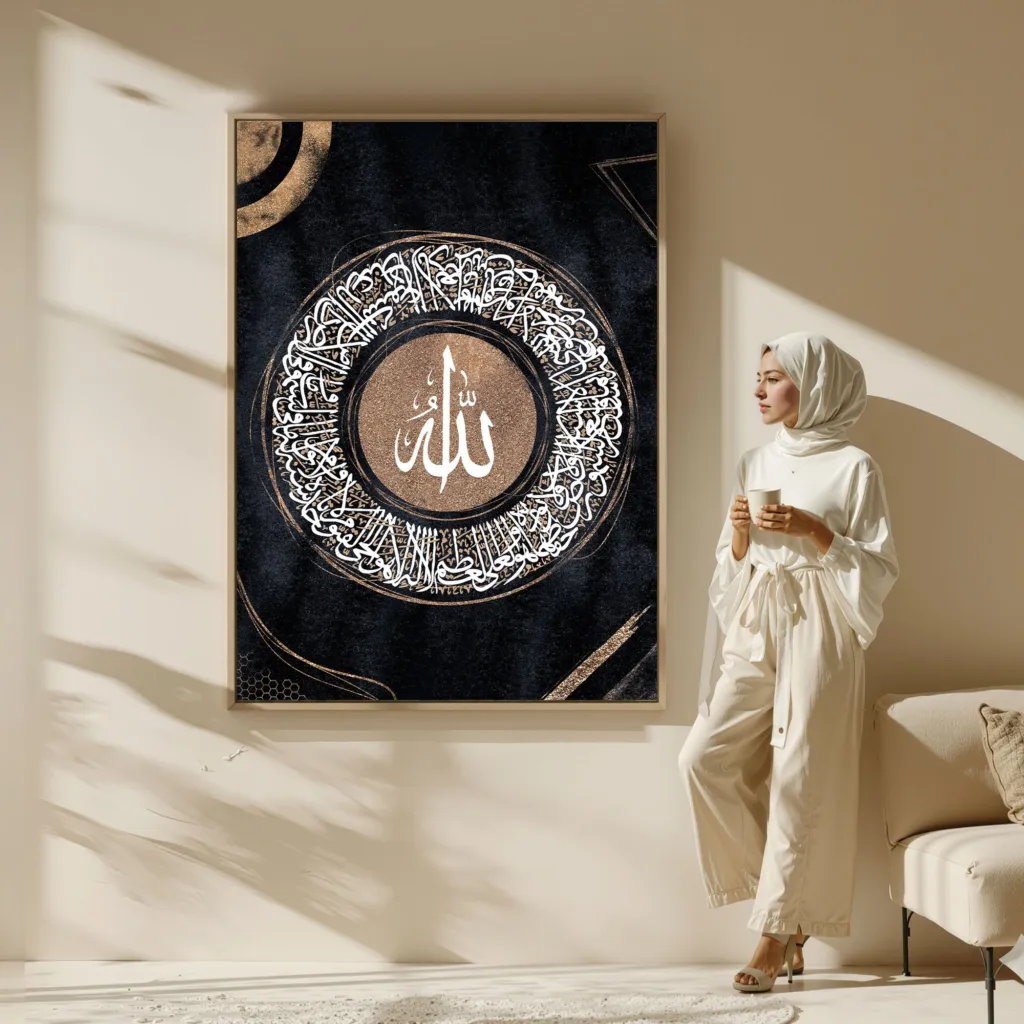
You can browse every design in our Ayatul Kursi wall art collection, printed to order on canvas in sizes from 12 × 16 to 45 × 60 inches, with or without a floating frame. If you are decorating for the holy month, see our Ramadan decoration ideas.
Frequently asked questions
What does Ayatul Kursi mean?
Ayatul Kursi means the Verse of the Throne (or Footstool). It is verse 255 of Surah Al-Baqarah. It describes Allah as the Ever-Living who sustains everything, who never tires or sleeps, who owns all that is in the heavens and the earth, and whose knowledge and authority have no limit.
What are the benefits of reciting Ayatul Kursi?
Authentic hadith describe it as the greatest verse in the Quran (Sahih Muslim 810), say that whoever recites it before sleeping has a guardian from Allah until morning (Sahih al-Bukhari 2311), and that reciting it after each obligatory prayer is a means of entering Paradise (an-Nasa'i, graded authentic).
Is it allowed to hang Ayatul Kursi on the wall?
Most scholars allow hanging Quranic calligraphy as a reminder, as long as it is treated with respect: kept clean, hung high enough, and never placed in a bathroom or anywhere it could be disrespected. Some scholars discourage it, especially if people treat it as a charm rather than a reminder. If you are unsure, ask a scholar you trust.
Where is the best place to hang Ayatul Kursi in the house?
The most common places are the living room, above the main entrance or in the entryway, a hallway, or above a prayer corner. Avoid bathrooms, the floor, and spots where it might be covered by coats or splashed by cooking.
Can I hang Ayatul Kursi in the bedroom?
Yes, many families do, often above the bed or facing it, since the Prophet taught reciting Ayatul Kursi before sleep. Keep it clean and in a respectful position, and some families prefer to keep it out of rooms where they undress, so a hallway just outside the bedroom is a common alternative.
Does hanging Ayatul Kursi protect the house?
The protection mentioned in the hadith comes from reciting the verse, not from having it on the wall. Wall art is best seen as a reminder to recite it, and many people find that seeing it daily helps them remember.